


GLI 201 ITALIAN FOOD AND CULTURE
Course Information
- About
- Introduction
- Learning Outcomes
- Expectations & Attendance
- Class Organization
- Assignments
- Course Calendar
- Bibliography & Readings
About
Instructors: Jessica Mancini (soul.food.philosophy@gmail.com)
Learning Facilitator: Alice Rossi info@borromini.institute
Credits: 3
Contact hours: 45
Offered: Summer
Language of instruction: English
Prerequisites: none
UIUC Articulation: To be discussed with your University of Illinois Academic Advisor.
Dates: Varies
Open to all majors and minors for general elective credit. Recommended for students in Food Studies, Italian Studies, Sustainable Food Systems.
Introduction
“To be interested in food but not in food production is clearly absurd”
—Wendell Berry
This highly experiential course will explore contemporary food systems in Italy, focusing on the relationship between landscape, agricultural practices, and the cultural history that defines Italy’s food identity. Students will examine the limitations of industrialized food systems, particularly in terms of sustainability challenges, global climate change and biodiversity.
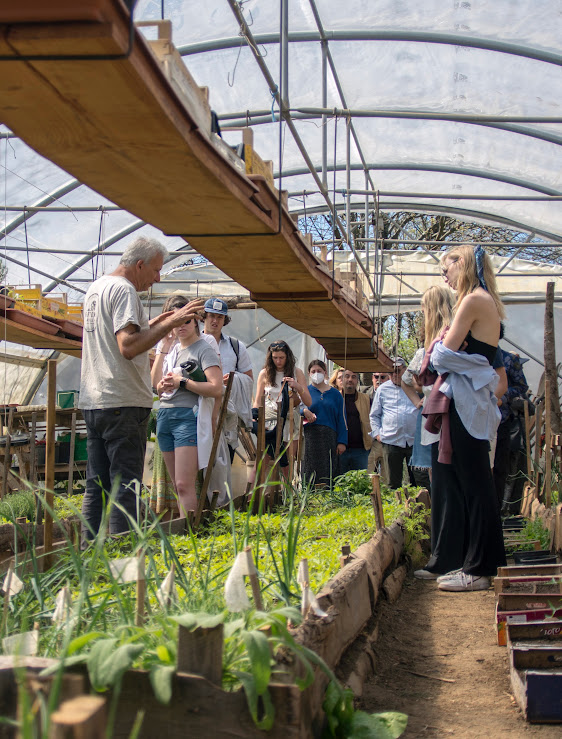
The course will begin with a focus on our relationship with the natural environment enquiring into the intersection between sustainable land management, food production and cultural heritage. Students will be immersed into the local farmland as they visit a number of agroecological farms, including a regenerative cattle farm, olive oil producer and a natural winery. These hands-on experiences will provide students with raw firsthand insight into the challenges of sustainable food production practices.
The second part of the course will shift to focus on supply as we explore alternative value chains and supply networks. Students will visit farmers’ markets, urban garden projects and a Community Supported Agriculture project (CSA). Through these experiences students will gain a deeper understanding of the role marketplaces and informal food networks have in promoting sustainability and preserving Italian foodways, while at the same time exploring concepts of community, social regeneration and food justice.
Finally, the course will move into the kitchen with culinary activities focusing on food waste reduction, the circular economy, and sustainable kitchen practices. Cooking classes guided by local experts will give hands-on experience based on traditional Italian gastronomic traditions including cooking and preservation methods. The practical insights gained in these classes will prepare students to be able to create a more sustainable home food environment.
The course will host numerous guest lectures from local experts that will allow the students to personally connect with local scientists, sociologists, activists, farmers and food pedagogues.
Assessment within the course is designed for students to connect directly with real-world challenges related to food systems, sustainability, and the environment in Italy. Through their own research students will uncover how food practices are deeply connected to the landscape, and fundamental to shaping local identities while promoting nutritional well-being and sustainability. Students will leave the course with a comprehensive understanding of sustainable food practices in Italy and their global implications.
Learning Outcomes
Students will cultivate the ability to critically evaluate food practices through a systems-based sustainability lens, considering the cultural and political context within Italy. By the end of this course, you will be able to:
- Identify the key historical, cultural and regional influences that have shaped Italian cuisine
- Distinguish between global industrialized food products and locally produced artisanal foods, demonstrating understanding through comparative analysis and relevant examples
- Explain and assess the significance of EU food certifications (e.g., DOP, IGP), the challenges posed by climate change, and the role of sustainable agricultural practices in shaping contemporary Italian foodways.
- Design, conduct, and present research that examines how food production and consumption practices contribute to the preservation of Italian culinary heritage, regional identity, and biodiversity, applying ethnographic research methods and critical analysis.
Expectations
You will be expected to discuss course readings in class and prepare short written assignments including reactions to the readings. Proofread your work before you submit it.
Take notes (and make sketches if you like) from the lectures and the sites that we visit to draw from for your assignments.
All work in the class will be based on lectures, videos, readings and on-site presentations. Stay close and stay alert. Ask questions.
All work must be completed on time. Permission for any late submissions must be requested to the instructor at least 24 hours before the deadline.
ATTENDANCE & PARTICIPATION
Being a student in Rome is a wonderful experience but prioritizing all courses is a must.
Attendance is required and will be taken at the beginning of lectures and site visits. This includes program excursions which are all mandatory.
Assigned readings must be completed prior to the weekly seminar and students must arrive prepared to discuss and/or write about them.
Much of the course will take place on site with thematic visits to parts of the city where the themes discussed in the lectures and readings can be observed.
Students are allowed no more than 2 unexcused absences; after the 3rd absence the grade will decrease by 1/2 letter grade or 5% per absence.
Unexcused absences include injury and illnesses that do not require medical attention; therefore, while it is your choice to skip class to travel or spend time with a guest who is visiting, you may regret that choice if you later become ill and have already used up your allowed absences. If you experience prolonged illness that will adversely affect your attendance, you will be asked to provide documentation of the illness and a plan approved by the instructor for making up for the missed work.
As soon as you know you will not be attending a class for whatever reason you are responsible for informing both your instructor and Learning Facilitator.
Class Organization
Notes on on-site lessons
The course will use experience-centered approaches to the subject matter, and active participation by the students will be an essential element of the course.
Much of the course takes place outside the classroom. Visits to markets, tastings of specific food products, both artisanal and mass-produced, will fuel discussions of food’s social and cultural significance in Italy.
These notes are to help students get the most out of the unique field learning experience:
- arrive at the assigned meeting place early; we cannot wait for late-comers
- stay close and stay alert, ask questions
- take notes and maintain sketches from the lectures and the sites that we visit to draw from for your assignments
- students will be required to have all the needed material with them, including the right clothes for outdoor visits
During the visits the students will need the following material/items:
- map, meeting address and suggested bus route. Don’t forget your monthly bus card
- comfortable walking clothes and shoes
- bottle of water
- depending on the weather, umbrella and rain boots /sunscreen, hat, sunglasses
- when visiting church: no shorts or short skirts, no tank top
- notebook with rigid cover, pen
During the onsite classes students will be provided with audio headsets. All students are responsible for the integrity and safety of their own headset and headphones. The audio-guides must be returned to the professor at the end of the class.
A note on “Critical Field Studies”
At the Borromini Institute we use ‘critical field studies’ to refer to courses where considerable time is spent observing and participating in activities in the ‘field.’ We recognize this as a distinct method of learning and one quite distinct from normal classroom activities. It requires students to be active learners, and to seek out learning opportunities often while working with or observing local people or specialists. Such opportunities are often explored with other members of the student group in research or ethnographic projects. Projects give students the opportunity to grasp the significance of behavior occurring in a second culture and to situate it using the best available ideas in today’s academy.
In the same way, we encourage our students to always carry a notebook and to use it to take notes or draw sketches whenever confronted by unusual behavior. Increasingly students are taking advantage of digital ways to record and edit local culture. Indeed, it is not unusual for students to present digital portfolios at the end of courses as part of their assignments.
Our courses are ‘critical’ in the sense that we ask students to study the way the world “is” but also to think about or design how it “might be” or “should” be. This argument goes beyond a “value neutral” position and suggests that we have created ourselves – and our world – in the Anthropocene era and bear responsibility for our collective future. It is, indeed, ‘our world’ and its future is in our hands.
Communication
The professor is always available during and after class to answer questions and can be contacted by email for additional feedback or clarification. Emails will be answered within 24 hours, and usually more quickly, unless otherwise indicated. To request an appointment to speak in person or video-conference send an email indicating the issue and possible times.
First-name basis is welcome but there is an expectation of professional tone in verbal and written communication. Salutation and sign-off are required in emails (essential to determine the intended recipient and sender) and avoid emojis and slang. Check your spelling and grammar before submitting any written work, including an email to your professor. (It’s a good habit to get into now).
Learning Facilitator
Students may also reach out to the Learning Facilitator to discuss general matters related to the course. The Learning Facilitator is available to provide practical support as well as assist students should any misunderstandings emerge in relation to their academic courses. For instance, any needs related to learning accommodations, drop/add period, or attendance policy should be taken up directly with the Learning Facilitator.
The Learning Facilitator is not a Teaching Assistant and as such cannot provide personal assistance related to course content.
First Amendment Protection
Gustolab International/Borromini Institute supports and upholds the First Amendment protection of freedom of speech and the principle of academic freedom in order to foster a learning environment where open inquiry and the vigorous debate of a diversity of ideas are encouraged. Students will not be penalized for the content or viewpoints of their speech as long as student expression in a class context is germane to the subject matter of the class and conveyed in an appropriate manner.
Non-Discrimination, and Anti-Harassment Policy
Gustolab International/Borromini Institute is committed to a work environment in which all individuals are treated with respect and dignity; discrimination and harassment of any form are strictly prohibited, as better explained in the Student Handbook.
Plagiarism
Plagiarism is a serious academic violation and should be taken seriously. One is responsible for plagiarism when: the exact words of another writer are used without using quotation marks and indicating the source of the words; the words of another are summarized or paraphrased without giving the credit that is due; the ideas from another writer are borrowed without properly documenting their source.
Accommodation for Students with Disabilities
Per Gustolab International/Borromini Institute policy and in compliance with the home university’s policies, students with a documented disability are required to communicate their academic accommodations and subsequently provide official written documentation. They are entitled to, and will receive, reasonable academic accommodations to ensure their ability to successfully participate in and complete this course. Such students must make an appointment during office hours to discuss any such disability with the instructor, and are responsible for bringing to the instructor’s attention any accommodation needs prior to or early in the term.
Pass/Fail (UIUC)
Students can request their grades to be pass/fail after they come back from their semester. This process differs from college to college, but it is always something that the student is responsible for. Gustolab International/Borromini Institute will report grades as normal and the student needs to work with their academic advisor in their home college for the pass/fail to appear on their record.
Drop/Add (UIUC)
Students should be enrolled in a full-time course load abroad. All students are enrolled in a full-time placeholder while they are abroad, but some colleges/departments will have their own requirements as to if they actually need to complete 12 credits abroad. Many majors do not require this in LAS, but it is part of advice by LAS that a student should always take a full-time course load abroad. Enrollment in specific courses cannot be guaranteed but depends on a minimum enrollment. Students may request to switch courses within the first week of the program and Gustolab International/Borromini Institute will attempt to grant such requests.
Assignments
Assignments
The course is structured in several phases, accompanied by on-site visits, lessons and activities.
15% In-class exam
Students will answer a total of 15 multiple-choice questions under exam conditions in class. Questions will be drawn from compulsory weekly readings and class content.
25% Class Participation
Students are expected to participate in spirited discussion by actively engaging in the course, taking notes inside and outside the classroom, carefully doing the readings and offering your own perspectives. Participation grades are not automatic and are based on oral contribution to the collective learning experience.
25% Local Food Map
Most of the food on supermarket shelves travels thousands of miles, often coming from distant continents. In your first assignment, you are to become an active part of your local food economy by avoiding shopping in supermarkets for a week. You will then create a map of where you sourced all your food for this week, and write a short reflection piece. Please see the assignment page and marking rubric for further details.
35% Endangered Food Project
An endangered food is an artisanal product or dish that is at risk of disappearing due to industrialization, migration, conflict or climate changes. In this hands-on project you will research and report on an endangered food product, coming into direct contact with local environments, producers, sellers and consumers. Please see the assignment page and marking rubric for further details.
Grading Criteria
The following general criteria will be used when grading all assignments:
- Research: the degree to which the student demonstrates that the subject matter has been adequately investigated. Grades will be determined by the ability to demonstrate in the assignments that material supports knowledge building by using empirical research –such as field observations–, theory, and practice wisdom
- Conceptual Ability: the ability to abstract concepts, think logically and organize ideas into a conceptual whole. Grades will be determined on the basis of the student’s ability to move along a continuum from abstraction to concreteness, to deal systematically with material presented in class, in readings and in field observations
- Communication: the ability to organize and transmit ideas in written, graphic, and, when appropriate, oral form. Students should strive to use proper syntax; express ideas clearly, punctuate, spell and, where appropriate, employ symbolic and visual modes of communication
- Analytical Thinking: the ability to analyze, present and evaluate concepts
- Timeliness and Completeness
Final grades are reported at the end of each term in the following way:
100% A+ Exceptional; significantly exceeds the highest expectations for undergraduate work
95% A Outstanding; meets the highest standards for the assignment or course
90% A- Excellent; meets very high standards for the assignment or course
85% B+ Very good; meets high standards for the assignment or course
80% B Good; meets most of the standards for the assignment or course
75% B- More than adequate; shows some reasonable command of the material
70% C+ Acceptable; meets basic standards for the assignment or course
65% C Acceptable; meets some of the basic standards for the assignment or course
60% C- Acceptable, while falling short of meeting basic standards in several ways
55% D Minimally acceptable; lowest passing grade
50% F Failing; very poor performance
Course Calendar
This outline is intended merely to present the course and its principle themes. It is subject to variation before and during the semester. Refer to the Google calendar for further details.
| SESSION | TOPICS | ACTIVITY | READINGS & ASSIGNMENTS |
|---|---|---|---|
| 1 WK 1 | MON 25th MAY 11.15AM -12.45PM Introductive lecture: Grounding down into place. Landscape, agriculture, and cultural heritage in Italy. | Lecture and discussion | Sjölander-Lindqvist, A., & Cinque, S. (2014). Locality Management through Cultural Diversity: The Case of the Majella National Park, Italy. Food, Culture & Society, 17(1), 143–160. https://doi.org/10.2752/175174414X13831235796855 |
| 2 WK 1 | WED 27th MAY 3.00PM – 5.00PM Bread Lab with Forno Culetti. Sustainable circular baker Mirko. | Bread Lab | Scott, J.C (2017) “Introduction: A Narrative in Tatters: What I Didn’t Know” in Against the Grain pp. 1-12 |
| 3 WK 2 | MON 1st JUNE 11.15AM -12.45PM Eco-gastronomic social movements in Italy. Slow Food philosophy and beyond. | Lecture and discussion | Meneley, A. (2004). Extra Virgin Olive Oil and Slow Food. Anthropologica (Ottawa), 46(2), 165–176 |
| 4 WK 2 | WED 3rd JUNE 3.00PM – 5.00PM Olive oil Masterclass with Paolo D’Andris. Award winning EVOO journalist and olive farmer. | Olive oil Lab | Montanari, M. (2013).‘Before there was an Italy there was an Europe’ in Italian identity in the kitchen, or food and the nation. Columbia University Press. Pp. 1 – 3 Meneley, A. (2004). Extra virgin olive oil and slow food. Anthropologica, 165-176. |
| 5 WK 3 | MON 8th JUNE 11.15AM -12.45PM The Impact of Climate Change on Italian Agriculture. The politics of Terroir, climate change and the natural wine movement in Italy. | Lecture and discussion | Daferner, M., Pütz, R., Steiner, C., & Rainer, G. (2025). ‘Nature in the glass’: Principles and practices in low-intervention winemaking. Applied Geography, 178, 103610. VIEW: Natural Resistance (Nossiter, 2014) |
| 6 WK 3 | WED 10th JUNE 3.00PM – 5.00PM Wine Lab with Sommelier Claudia Paella. | Wine Lab | |
| 7 WK 4 | MONDAY 15th: 11.15 AM -12.45PM IN- CLASS EXAM | ||
| 8 & 9 WK 4 | THURSDAY & FRIDAY : TUSCIA TRIP | ||
| 10 WK 5 | MON 22nd JUNE 11.15AM -12.45PM Trionfale market field trip. Understanding the role of the marketplace and overview of the Italian foodways | Visit to Trionfale market guided tour | Steel C. (2013) Market and supermarket in Hungry City : how food shapes our lives. Vintage. VIEW: Steel C (2009) How Food Shapes our Cities, Ted talk |
| 11 WK 5 | WED 24th JUNE 3.00PM – 5.00PM Seasonal vegetable cooking class. Learn how to cook in season and from scratch Italian style. | Cooking class | Wrangham, R. W. (2009). Catching fire: How cooking made us human. Basic Books. |
| 12 WK 6 | MON 29th JUNE 11.15AM -12.45PM Alternative food networks in Italy. The Short Supply Chain, Farmers markets and Genuino Cladestino. | Lecture and discussion | Smith, G. Berruti, G. (2023). Alternative value chains in The Landscapes of Italian Food: Local Development and Healthy Practices. 10.4324/9781003279914. |
| 13 WK 6 | WED 1st JULY 3PM – 5PM ROMAN COMMUNITY URBAN GARDEN TOUR or CORRAGGIO or CSA- semi di comunita. | Field Trip | Ikeda, M., Akiyama, Y., Wiesenberg, S. (2023). The Role of Urban Gardening in Global Cities: Three Case Studies in Berlin, Rome and Tokyo. In: Grover, A., Singh, A., Singh, R.B. (eds) Sustainable Health Through Food, Nutrition, and Lifestyle. Advances in Geographical and Environmental Sciences. Springer, Singapore. https://doi.org/10.1007/978-981-19-7230-0_14 |
| 14 WK 7 | MON 6th JULY 11.15AM -12.45PM Italian Food Identity Food Waste, Circular Economy, and Sustainable kitchens | Lecture and discussion | Fassio, F., Cionchi, E. and Tondella, A. (2020) “The circular economy for food in future cities. Good practices that define Smart Food”, AGATHÓN|International Journal of Architecture, Art and Design, 8(online), pp. 244–253. doi: 10.19229/2464-9309/8232020. |
| 15 WK 7 | WED 8th JULY 3PM – 5PM Traditional preserving techniques with Lucia. No waste kitchen Italian style with no waste expert Lucia Cuffaro. | Cooking class | Excerpts from Counihan,C.M (2004) ‘Food and gender: toward the future’, in Around the Tuscan Table. Routledge |
| 16 WK 8 | MON 13th JULY 11.15AM -12.45PM The Politics of Food in Italy Labor Rights,immigration and Gastronativism. | Lecture and discussion | Kihlgren Grandi, L. (2023). Branding, Diplomacy, and Inclusion: The Role of Migrant Cuisines in Cities’ Local and International Action. Societies (Basel, Switzerland), 13(7), 151. |
| 17 WK 8 | WED 15th JULY 3.00 – 5.00PM Final project presentation STUDENTS FILM SCREENING |
Course Related Field Trips
During the program there will be a number of program excursions with components related to each course. Each semester these change depending on the season and general teaching opportunities. Occasionally, short assignments from these field trips will be included in the class participation component of the course grade.
Bibliography
The principal readings this semester are listed below and noted in the course calendar. A digital copy of all required readings will be provided in PDF format. An additional bibliography of suggested and recommended readings is provided below to assist students in their research. Some of these readings will be provided as digital downloads.
Counihan, C. M. (2004). Food and gender: Toward the future. In Around the Tuscan table. Routledge.
Daferner, M., Pütz, R., Steiner, C., & Rainer, G. (2025). Nature in the glass: Principles and practices in low-intervention winemaking. Applied Geography, 178, 103610.
Fassio, F., Cionchi, E., & Tondella, A. (2020). The circular economy for food in future cities: Good practices that define smart food. AGATHÓN: International Journal of Architecture, Art and Design, 8, 244–253. https://doi.org/10.19229/2464-9309/8232020
Ikeda, M., Akiyama, Y., & Wiesenberg, S. (2023). The role of urban gardening in global cities: Three case studies in Berlin, Rome and Tokyo. In A. Grover, A. Singh, & R. B. Singh (Eds.), Sustainable health through food, nutrition, and lifestyle (Advances in Geographical and Environmental Sciences). Springer. https://doi.org/10.1007/978-981-19-7230-0_14
Kihlgren Grandi, L. (2023). Branding, diplomacy, and inclusion: The role of migrant cuisines in cities’ local and international action. Societies, 13(7), 151.
Meneley, A. (2004). Extra virgin olive oil and slow food. Anthropologica, 46(2), 165–176.
Scott, J. C. (2017). Introduction: A narrative in tatters: What I didn’t know. In Against the grain (pp. 1–12).
Sjölander-Lindqvist, A., & Cinque, S. (2014). Locality management through cultural diversity: The case of the Majella National Park, Italy. Food, Culture & Society, 17(1), 143–160. https://doi.org/10.2752/175174414X13831235796855
Smith, G., & Berruti, G. (2023). Alternative value chains. In The landscapes of Italian food: Local development and healthy practices. https://doi.org/10.4324/9781003279914
Steel, C. (2013). Hungry city: How food shapes our lives. Vintage.Wrangham, R. W. (2009). Catching fire: How cooking made us human. Basic Books.